Family life
Dubai Creek Harbour family guide: daily life with children
Families do not choose Dubai Creek Harbour because of marketing language — they choose it because the shape of the place usually works for daily life with children: you can walk for a stretch of the week, the community is managed in a way that feels legible, things are close enough to matter for time and school runs, and you can build routines (even when those routines are mostly: car, lift, then walk). The tradeoff is the same as elsewhere in a big Dubai master plan — heat, access rules, and your specific tower, not a generic “family” label on a map.
Ask verified residents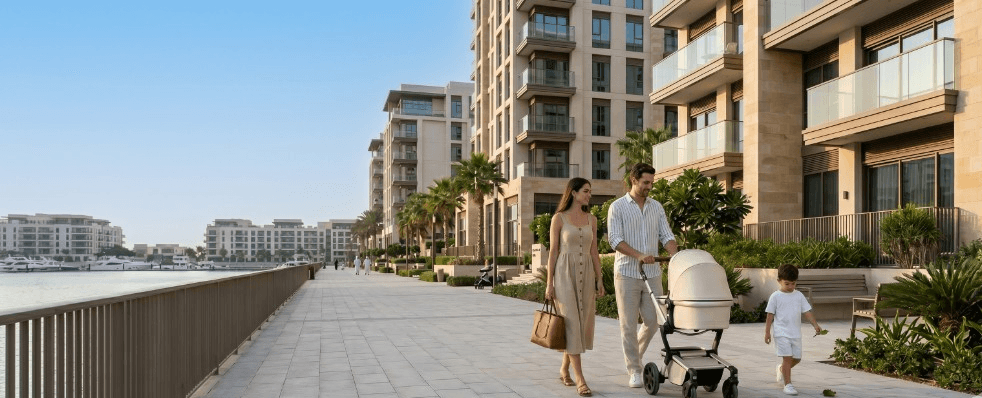
Walkability matters in short bursts: promenades, podiums, play pockets — not every errand, but more than a tower-only car park. Safety is felt as gating, visibility, and habit, not a slogan. Proximity is real for some things (podium shop, a clinic run) and not for others (the school you actually picked may still be a drive). Routines here are a mix of foot, fob, and who is home when the driver calls.
The sections below are differences in the day, not a sales pitch. Check notices and other parents in your line when something is tower-specific; this page is a handrail, not a contract.
Creek Beach vs. Island vs. the rest
No precinct “wins” in the abstract. Families feel different friction in each: shorter paths here, more vertical steps there, mixed habits somewhere in between. That is the useful contrast.
Creek Beach (lower-rise clusters). Often fewer lift transfers to reach a door or a shared play patch; a flatter run from pram to path for some units. Daily life can feel direct in a “out the door, onto the path” way — not easier in every way, but simpler in how much building sits between a nap and a walk. Guest parking and pram routes still follow local rules.
Island (towers). More time in lobbies, lifts, and the decision of which bank of elevators to use. School bags, scooters, and a second car seat often mean more planning in the same clock — peak lift waits, a longer hop from car seat to play if you are coming from a basement level, balcony and window habits worth naming once the kids are mobile. None of that is a flaw; it is a shape of day.
The rest of the community (other clusters and pieces of the plan). A mix: some families get a mid-rise rhythm, a shared pool that is a short walk, or a run that is neither full Creek Beach nor a single high-rise core — the detail is the building and cluster you are in, not a colour on a map.
The point is to match your child age and patience with the access story you are signing up for, not to rank neighbourhoods from outside.
A normal day with kids in Dubai Creek Harbour
Mornings — school, nursery, or a slow start. A typical weekday: bags at the door, a debate about shoes, then either a run toward the school you already picked — often hubs like Al Jaddaf or Nad Al Sheba are in the conversation, with a time buffer for traffic out of the community, especially from the Island — or a shorter hop from a lower-rise side, or a nursery line that already feels like small talk with the same guard. The logistics is “when do we leave so we are not late,” not the view from the sales deck.
Afternoon — play, pram, heat. If it is cooler, the promenade or a cluster play spot fills: scooters, a slow loop, a splash pad if your cluster has the rhythm. If it is hot, the honest pattern is shorter outside windows, a pool hour that fits the building rules, or a cool lobby / indoor swing between homework and dinner. Fussiness is as often about sweat and timing as about the equipment.
Evening — short return vs. a necessary drive. A litre of milk, a prescription, a last food run: some people walk a podium; some will not, because heat, a sleeping toddler, or “the car is already in the right zone” matters more. Neither is a moral choice — it is what finishes the day with least chaos.
The small, repeated bits. A delivery when only one parent is home, a grandparent at the wrong lobby, a child who has to use the bathroom the minute you pass the security line — the day is that texture. Recognizing it is the point; perfect flow is not the promise.
What matters more than you think
The list below is the stuff maps and tours underrate:
- Lift wait at school and work peaks — a stroller, a child who cannot hold a long “we are almost there” yet, and one slow bank of lifts change the feel of a tower more than a brochure floor plan.
- Distance to your real errands — the milk run is not “nearby” in the map sense if the walk is open sun in July, or the lift adds eight minutes. Know your honest five-minute and fifteen-minute orbits on foot and by car.
- Stroller reality — ramps, podium steps, “push here not there,” a security line that is fine when you are alone and awkward with a pram. Test once when you are not late.
- Heat for most of the year — which outdoor stretch is shadier at your 5pm in May, when you really move indoor, and when you are willing to be heroic about a walk. Small adjustments matter more than ideology.
- Delivery when someone small is home — intercom, door, a missed nap because the buzzer won’t wait; the same access chain the delivery guide talks about, with more emotional load.
- Access for the people you rely on — grandparents, a babysitter, a one-off help: parking story, which lobby, whether they are cleared up — if that is shaky, your evening plan is shaky too.
The first two weeks with kids
A practical slice while boxes still talk louder than the view:
- Map your default routes — to bin, to car, to the one shop you will use, to the first playground you can reach without a meltdown. Walk them empty once.
- Read delivery and gate like a system — who buzzes, where heavy boxes go, what your child does during a ten-minute driver confused at the wrong kerb. Adjust notes in apps early.
- Test pool and play at two different times — a quiet swim vs. a full hour; a play patch at school-out vs. weekend. Rules on paper vs. the room when it is busy are different things.
- Clarify access for anyone who will help — a written line for a babysitter and for grandparents: entrance, name at desk, whether they meet you in the lobby. Paste it before you are tired enough to get vague.
- Name fallbacks — an indoor break you already scoped, a pharmacy or store you checked once so a sick night is not also a wayfinding project, a friend or neighbour in the line you can call when the intercom and the child disagree.
Pools, playgrounds, and building etiquette
Most family clusters and towers have shared play and water space; the useful detail is the house rules where you live: quiet hours, adult in the water, how many guests a unit may bring, what “kids’ pool” means in practice. Afternoon and weekend use shifts with the weather and the school clock — not better or worse, just congested in predictable windows. A little patience in a lift and a little clarity at the desk usually go further than a long post in a group.
School, nursery, and the morning run
Older children often leave the area for school — Jaddaf, Nad Al Sheba, and other hubs are common in conversation; your seat on the bus or your time to the first barrier is a household number, not a DCH claim. Buses, carpools, and two-household timing are the usual workarounds when traffic is thick.
Younger children may use nurseries in or just outside the path parents already drive. Fit is hours, handover at the door, and whether a sick-day pickup matches your work story — other parents in your line often have the most recent read on a place.
Groceries, pharmacy, and the day that will not wait
A household with children is a chain of small crises: a formula run, a fever, a last ingredient. Podium retail, local branches, and apps are all in play; in some buildings the long grocery drop is a service path, not the lobby, which matters when a child is tired of waiting. The family angle is the same access and timing the delivery and parking guides describe — with less margin for a missed buzz.
When you need a neighbour’s answer
A public page cannot know if your kids’ pool is closed this week, which paediatrician the parents on your floor are using, or which babysitter already has a badge your desk recognises. ourcreekharbour.com is a place verified residents can ask that layer of thing — not a replacement for a school tour or a medical choice, a calmer line to people who share your barriers. If that helps, ask verified residents when you are ready.
For verified residents
Want building-specific answers?
The public guide gives orientation. The verified resident app keeps the live neighbour details private, current and useful.
Get resident guidance